Thursday, May 24, 2018

You Load Sixteen Tons ...


Well. maybe not sixteen tons, but at about 40-50 lbs per bag, 45 bags of mulch weighs around one ton. Home Depot delivered the mulch this morning. I know what life will be like for the next few weeks, and it is not a pretty picture.  [Anybody else remember Tennessee Ernie Ford? :) ]

There was a bit of a kerfuffle when the Home Depot delivery guy found out he couldn't drive the mulch to the back yard with his forklift. Aside from the gate being too narrow and the utilities pillar being in the way,  it would have torn up the grass. He said he could only do a curbside delivery even though I paid for inside delivery. I'm glad he phoned before coming out. I talked to the HD manager on duty and only had to threaten to cancel the order once. They worked out a solution.
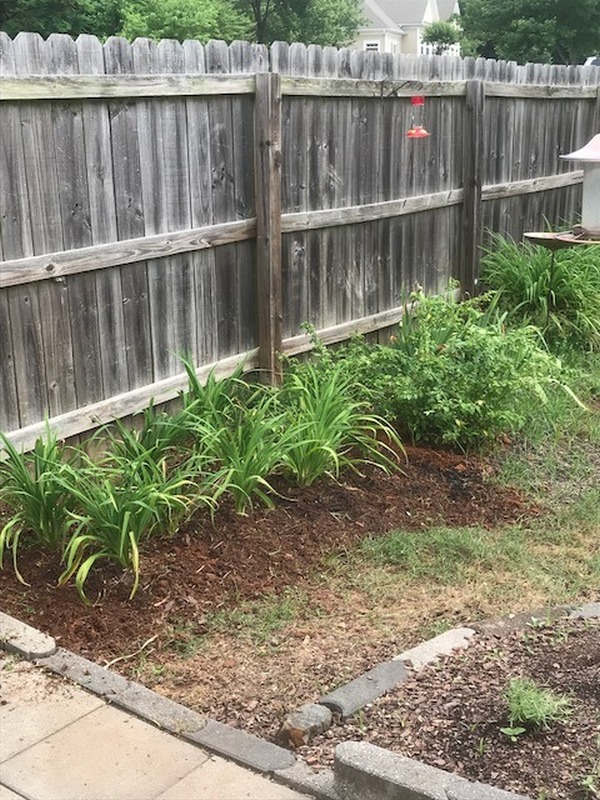
This is where the mulch will go. Note the mold on the gate and wall. While I waited for the delivery, I scrubbed it clean, inside and out. The bag-covered BBQ grill was moved to the other side of the shed. This area is covered with some kind of landscape cloth and a layer of pea gravel. The concrete pavers lie on top the gravel and tend to skate around. One day I need to arrange them as I want them and scrape out the gravel underneath, so they will sit firmly on the landscape cloth. I think that will help keep them in place.
This is the truck that brought the mulch. It is huge, with the forklift hanging off the back.

The HD delivery guy dropped the mulch at the curb, as he said he would. Forty-five bags on a palette.
This is the Home Depot Pro Delivery truck that brought Kevin and his wheelbarrow.

This is Kevin moving the mulch with a wheelbarrow. He made a nice, sturdy pile, five bags per layer, nine layers high. 

Here is the mulch, neatly stacked. Please note the nice, clean gate. :)
Kevin offered to haul away the wooden pallet, but I recalled a neighbor across the street mentioning building something out of pallets. He was happy to come get it.

By the time the delivery was complete, the fence and gate hosed down, and a hundred feet of hose was cranked back into its little house, it was too hot and muggy to do much outside work.

Mystery solved: I came in and Googled "purple star flower" and found out the mystery flowers from the previous post are Balloon flowers - Platycodon grandiflorus. Click on the Older Post button below and scroll down for a link that explains it. In short, I'm glad to have a lot of them in the yard.


Wednesday, May 23, 2018

Disgruntled Pigeons -- Hooray!!


It's still raining on and off, but I managed to get in a goodly amount of weeding this morning while the cloud cover held. When the sun came out around 10:30, I had to retreat, as heat and humidity increased rapidly.  (Don't forget to click on photos for a larger version.)
Weeding finished along the first four sections of fence; eight to go. Most of the really dense weed patches have been dealt with. The bench/kneeler is a handy tool. I'm not much good at kneeling, but sitting on the bench and leaning down to weed is great. See how well the lavender is growing under the bird feeder. The pigeons haven't harmed it. I swear it has nearly doubled in size. (And yes, I see that area needs weeding.) 
The earlier weeded sections are beginning to green up again and will need to be revisited before they are mulched. Home Depot is delivering 45 bags of brown mulch tomorrow. I paid extra to have it delivered inside the gate. From there I can load a bag at a time on my little garden wagon and pull it to where it is to be spread.

The new caged bird seed feeder is working. The sparrows and smaller birds can easily get through the 1-1/2" openings, but the larger birds are baffled. I haven't seen any cardinals attempt to get inside the cage. I'm afraid they may be a tad too big. I'm thinking about making a dome of chicken wire to put on the ground to protect a plate of sunflower seeds. The cardinals should be able to get in but not the pigeons.
I don't know what kind of bird this is, but he's doomed to go away hungry. It's hard to see, but there is a hummingbird at the feeder drinking out of the yellow flower on the left side. I know, just a blur, but I had to share. :) The hummers seem to have given the feeder a 5-star rating, as I now see them morning, noon, and evening. One buzzed near my head when I was weeding beneath the feeder a day or so ago. 

This is what getting the caged feeder is all about. No way is this pigeon getting any seed unless the smaller birds drop some on the ground. They tried hard the first few days. Now they just stomp around underneath. If I were to open the door a crack, I'm sure I'd hear them expressing a high degree of disgruntlement.

In the nursery department, the red stem dogwood and the slow-growing Rose of Sharon seem to be holding their own.
It's difficult to see the red stems against the red Georgia clay, but my goodness won't this be a standout come winter. In the spring it will sport white flowers. It seems to be settling in well. No droopy leaves.

I made another attempt to photograph the tiny leaves on the slowest Rose of Sharon bush. I put my hand behind the branch in an attempt to get the camera to autofocus on the leaves, not the far background. The leaflet on the right may be a quarter inch long. This is bigger than its earlier efforts to produce greenery. I've been talking nicely to it, words of encouragement.
The other newcomer, the Tuscarora crape myrtle, seems to be doing all right off by its lonesome in the side yard. This area is a real mess, with pea gravel and bricks sliding down the slope from house to fence, and not a blade of grass in sight. 
The crape myrtle doesn't add anything to the backyard landscaping. In fact, it is out of sight and nearly always out of mind. Its contribution to the effort will be blocking the view of the neighbors from the office and studio with its dense foliage and lovely coral colored blooms. Can't wait for it to grow!
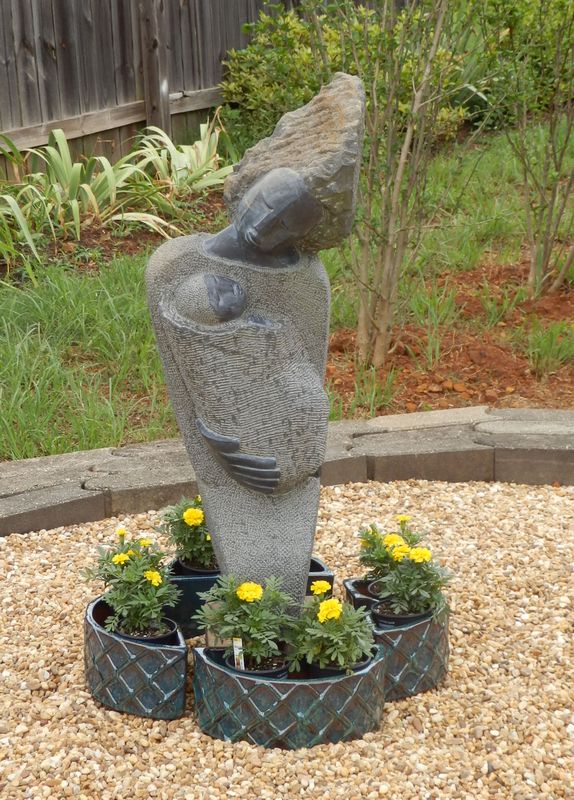
The umbrella pots around the statue are working out well. The marigolds add a nice pop of color without overpowering Mom and babe.
I think the proportion will be better after the pots are settled down into the inch or inch-and-a-half of pea gravel. It's on the To Do list!

And now, the mystery of the day. What are these flowers? The former owner must have loved them, as they are planted all over the place. I need to take one to a local nursery for identification, unless one of you can solve the mystery.

This is what they mystery flower looks like as its buds swell.
The balloon-like buds pop open to become a lovely star-shaped flower.
 If you know what these are, please respond in the comments below. Thanks!!

Edit: When my brother thought they were called something like Balloon Flowers. He was spot on! I Googled "purple star flowers", and there they were. Thanks, Rich! Apparently they are hearty perennials that can withstand short bouts of drought and come back smiling year after year. The article says they bloom in mid-summer, but here in Georgia they are blooming the 3rd week in May.

Sunday, May 20, 2018

Rain, rain ... *sigh*


After a week or more of rain, the greenery is going gangbusters. This morning I weeded the first section of fence. I think about the long skinny flower bed in terms of fence segments so as not to be overwhelmed. 
There are 10 or 11 sections in the fence. If I do one a day they'll get weeded every 10 days. That's the plan, anyway.
The next photo shows the weeded section plus the three French lavender bushes beneath the bird feeders and the hummingbird feeder, which was moved to the fence. The lavender is growing nicely. In a few weeks it should be a foot or more high and begin producing beautiful, fragrant blossoms. I fell in love with the lavender when we were in France and had some in the Missouri garden. I'm so looking forward to it blooming!

Yes, the feeders are empty. I left them empty to discourage the shack bully pigeons who not only drained the feeders but stomped around beneath them and pretty well killed anything planted there. I've ordered a new feeder, one with a cage around it that is supposed to let in small to medium birds but keep out larger birds and squirrels. If it works well, I'll get a caged suet feeder, one that will keep out the starlings.

This morning I spotted a hummingbird at the feeder. It is maybe not the first one, as the level of nectar has been dropping, but the first one I've laid eyes on. Happy day!
The first section is weeded but not edged.
This view shows the raggedy edge of the flower bed. When I was in Missouri I had a step-on edger that made quick work of tidy edges. When we moved, I bequeathed it to my dear friends as I'd have no need for it in the condo. Well, life intervened. When I moaned that I could not find another -- it is out of production and nowhere to be found -- they generously offered to ship it back to me. Now they are even dearer friends. ☺ Can't wait for it to get here!
As I weed, I need to mulch, but first need to create a clean edge. [Note to self: see if Home Depot will deliver bags of mulch.]
 The next photo shows the weeding that lies ahead ... some areas are very dense with weeds and others not so much. The next section of fence is going to be a headache to weed, but it is supposed to be cooler with no rain tomorrow and the ground will still be relatively soft from the rain. 
On the patio, a new white planter, and along the fence a new birdbath.
The new planter with lavender and white calla lilies that were around the statue in the island. They won't stay here permanently. Not sure where they'll end up.
Now a trip to the island ... I wasn't really happy with the statue being semi-hidden among the pots of calla lilies and ferns. Then I found planters that are designed to to be used on a patio table on either side of the umbrella. Perfect! They will be settled into the pea gravel a bit so the tops will be level with the base. I think rather than adding dirt, I will put in small pots of blooms so they can be changed out as the season and my whims demand.


Just behind the island are the six Rose of Sharon bushes that were transplanted. Three are growing heartily, two are not quite so robust but are bravely leafing out, and then there is this one. It puts out microscopic leaves that seem to be there one day, gone the next. It must still be alive. I'm hoping it is busy putting out a sturdy root system and will direct energy to leaf production when it's ready.
The arrows are pointing to microscopic leaves. This Rose of Sharon is apparently alive but its growth rate is definitely not as good as its brothers and sisters. [Click on the photo for an enlargement. Sorry for the blur. The growths are sooooo tiny!]
Two more plants have been added to the landscape, a red stemmed dogwood to add a bit of winter color and a Tuscarora crape myrtle outside my office and studio, which will have coral colored blossoms. Mini update: the three paulownia trees are growing well. Photos to come.

Wednesday, May 9, 2018

A Tale of Two Trees


When we lived in Missouri, there was a plant in the garden that had me perplexed for several years. It  had a woody stem that grew rapidly and produced dinner-plate size leaves. It was not in a good place for my overall garden design, so for three or four years I cut it off at ground level, not being able to pull or dig it up where it grew amid some rocks. And every year it came right back. I finally searched out what it was: a Paulownia elongata.

With its promise of growing up to 15 feet in a year and producing shade and beautiful flowers, I thought would be perfect for my current yard. My local landscaper was not familiar with Paulownia, so I found a Georgia nursery that carried it and ordered two of them on line. (You can see the bare root sticks in the previous post.) The photo in their ad was of Paulownia elongata, as was the description.

As the twin Paulownias began to put out leaves, I was confused. Their leaves were the wrong shape and had a fuzzy surface, not the smooth leaves I was expecting. I queried the nursery, which never got back to me. (As of 9 May 2018, the page for their Empress Tree/Paulownia has been taken down.) Google helped me discover that there are multiple species of Paulownia, and what I had was Paulownia tomentosa. Who knew?

Paulownia tomentosa in my yard in Georgia

Meanwhile, the Russian pomegranate from the same Georgia nursery never did sprout. When I spoke via telephone to their Customer Service department, I was told that it was a very slow growing tree, that they'd had some planted for several months before they began to show new leaves. Ha. I know a dead tree when I see one. And I want something that will grow quickly!

I went online again and ordered a Paulownia elongata from a different nursery, this one in North Carolina. It it wending its way to me as I type this. When Joe showed up with his auger to dig a hole for a crape myrtle that is yet to be purchased, I had him remove the pomegranate and enlarge the hole for the Paulownia elongata

I thought I'd do a good thing and fill the hole with water, so the ground would be good and wet for the new Paulownia. That was before I read that Paulownias do not like to be over-watered. 

Hole for Paulownia elongata, about 7 hours after being filled to the top with water. Only about a third of it has soaked into the dense Georgia clay.
So the tree isn't happy to have its feet wet, and here I am placing it in a mini pond. (As of this morning, about 20 hours after adding the water, the hole is empty but still very wet.)  I have some Miracle Gro soil amendment to mix with the clay when the tree is planted. I'm hoping it will aerate the soil enough so that water will drain away from the roots when it rains. I'll be watering only sparingly during the hot, dry summer months. If it manages to live through the spring rains, it ought to be okay.

Meanwhile, I found some beautiful lavender and white calla lilies at Home Depot. I bought several pots of them, along with some ferns, for the mother and child statue. There is a weed barrier beneath the pea gravel, so they can't be planted in the ground. Until I find suitable containers, I'll dig the pots in so the bottom 2-3" will be hidden by the pea gravel.

The calla lilies are a beautiful lavender and white, which does not show up well in this photo.
The island is shaping up. The chairs are from Walmart, the tri-level table from Hobby Lobby.

The island is a pleasant place to sit in the morning, before the sun gets too hot. 
Yesterday three lavender plants arrived looking healthy and happy and ready to add fragrance to the garden. They'll be planted today, beneath the bird feeders.

Saturday, April 14, 2018

The Garden Grows!!


Although our weather has had its ups and downs, temperature-wise, over the past week, the garden is growing. I have to admit I've been like a mother hen hovering over her chicks, checking to be sure nothing was wilting and looking for any sign of revival in the three bare root additions, the Russian pomegranate and the two paulownias. Today, a week after the great makeover --- partial success!

Empress Tree 1, a paulownia, has sprouted! It should grow quickly. This isn't a good photo for the background, but there's a hint of the iris blooming along the fence, and the azaleas by the house are blooming gloriously full and brilliant.

Empress tree 2, the other paulownia, has also sprouted, but not quite as robustly. It gets slightly less sunlight, which may be why is is a bit behind its sister on the growth spectrum. I've marked the two most obvious leaf buds with the arrows.  

The Russian pomegranate, on the other hand, has lost the few leaves it came with, and appears to be quite dead. I'm hoping to see some growth at the base in the next several days. 

Friday, April 6, 2018

Georgia: Phase One complete


After three days of 2-3 men working hard and me supervising, Phase One was complete. Hardscape finished, existing plants transplanted, and new trees and bushes planted. We did not accomplish everything on the initial Plan. It was a guideline, not a hard-and-fast plan. As the garden shaped up, I decided not to go ahead with some facets of the plan. I am pleased with how it is turning out. I can muster enough patience to watch it grow before moving to Phase Two.

The following photos were taken April 6, 2018. Click on a photo to see it larger.


This is the view from the back porch. Eventually those three lone Emerald Green cones will get as big as the one on the other side of the fence. They will form a screen of sorts. Jody warned me not to overwater them. Water the rest, he said, but the Emerald Greens don't want too much water.


The island is the focal point of the garden. It is backed by six Rose of Sharon bushes rescued from certain death where they were planted too close to the fence. The dogwood is difficult to see in this photo with its white blossoms against the white back fence, but it is centered. Two Empress trees (paulownia) are planted on either side of the dogwood. Those three trees will grow above the Rose of Sharon bushes and add some nice height (and privacy) to the design.


The tiny back porch and patio have seen the least amount of change. Buddha is sitting on his drum in the former fire pit, now dirt-filled. There was room for a few lilies from Home Depot. I have no idea what color they will be. Behind him is a small shed for garden tools and birdseed. This area needs attention -- some comfortable chairs and some kind of shade. The house next door is not nearly so visible when you're actually standing there.

The azaleas behind the house were not touched but for a little week-pulling. I'd thought about moving them, and still may, but for now they are resting in peace.

This view shows the widening of the planting bed along the fence. There are transplanted lilies right next to the patio. The bush beside them is a Japanese quince. Its beautiful coral-colored blossoms are finished for now, something to look forward to next spring. On this side of the quince are transplanted irises, then more daylilies. Not sure what the purple flowers are; left them there as they seem happy.
Backing toward the back fence, the long view of the transplants can be seen. The bush in the middle is a forsythia. Like the Japanese quince, it is finished for this year. The purple flowers in the foreground mark the end of the transplants. From there to the back fence there is an undisturbed clump of iris and five larger azaleas that Jody didn't think would survive transplanting. The dogwood is a Cherokee princess. It is placed so that when looking at it from the house (porch), it appears through a break in the wall of Rose of Sharon bushes. That brown spot to the right of the dogwood is a tree-to-be. It is Empress 1, a paulownia that will grow quickly from bare root to majestic. That's the plan, anyway.☺
Here's a closeup of the paulownia. Doesn't look like much, but like that silly old ant, we have high hopes. It has a mate of similar appearance on the other side of the dogwood, just outside the photo above.

Back toward the front of the house, opposite the Japanese quince, are two more forsythia bushes. They will be a lovely blaze of color in the spring. The white tag is on a Russian pomegranate, bought bare root from Tyty Nursery in Tyty, Georgia. It is supposed to be hardy enough to withstand our zone 7 winters. It looks every bit as dead as the two paulownias, but -- high hopes!
In the back corner are some sickly looking azaleas. They are different from the healthy batch up near the house. Their blooms are all on the bottom. I need to learn more about azaleas!
Across the way from the sickly azaleas there was a Knockout rose that was incredibly overgrown. It didn't appear ever to have been pruned. It was as tall as the fence, a good 6 feet. It has been cut waaaay back, but should revive. There was a little ivy vine hiding beneath it, as well as a baby snake about the size of a robust earthworm. There was some debate among the crew as to whether is was a copperhead, but no agreement was reached. 

And so it stands. Time to haul out the hosepipe and start watering. 

Georgia: Work in Progress


I am lucky to have a landscape gardener who comes highly recommended by my sister. Joe Graham and his workers from Graham Yard Makeovers, Dallas, Georgia, are the fellows in the bright shirts that you'll see in some of the following photos.


We  started out with a general plan. Placement of the new plants and trees was predicated on the view lines between the house and the houses to the right and behind the yard, most of which are two stories and peer down into the yard. Click the diagram to see a larger view, but if it is not readable, not to worry. All will be explained as we tour the garden. 

Joe and Tom with the auger. Not having any experience with the Georgia red clay, I was surprised to see the arrival of the auger. As Joe pointed out, digging holes with this machine was quicker than trying to hand dig, plus it turned the solid clay to a nice powdery texture, great for the new plant roots. This hole would be for the Japanese quince, seen at right.

They also used the auger to till the top few inches of clay where the iris and daylilies were to be transplanted. The loosened clay was mixed with a Miracle Gro product designed to amend the local dirt. The compost and fertilizer will make the transplants very happy.

Nearly all of the edger bricks were relocated to the island. Joe and crew put down a barrier mat and arranged three rows of bricks in a fluid oval. It appears to slant slightly to the left, which is good for drainage and not nearly so noticeable in person.. We didn't want it to turn into a wading pool after a hard rain.

The augering continued after the island was complete. The six Rose of Sharon bushes moved from along the fence to form a natural fence behind the island.

Here you can (barely) see the Rose of Sharon bushes behind the island. To the left you can see where some of the sod was removed to expand the planting area along the fence to accommodate the Japanese quince.
I had intended to take more photos of the work in progress, but I got so involved with the process that I forgot the camera. What followed this basic makeover was the relocation of the many iris and daylilies and the addition of more bushes and trees. In the next blog installment, I'll show you how that turned out.